Anthropic, Day One!
Just a quick thought on the day that the Anthropic public offering goes live …
There is a lot of chatter and excitement in the financial world surrounding artificial intelligence, which, if you are a true believer, is about to change absolutely everything.
Which is nonsense, but I will get to that in a moment.
For now, I want to focus only on the concerns lurking in the background about the possibility that the current froth might just be that … froth … and not much more. The question that keeps coming up concerns the chance that we are stuck somewhere in a financial bubble. Are the expectations and valuations out of whack with the likely reality? If so, when does that reality catch up with the dream world currently, apparently, befuddling what we are all told our “perfect markets”?
One contrast being drawn is that last really big bubble. Setting aside the catastrophe of the great financial crisis when our financiers drove us all over a cliff, the last real “bubble” was the dot.com version that burst at the end of the 1990s and into early 2000.
Back then, the bubble was obvious: stick prices were so far out of kilter with earnings that it took no analysis at all to suspect that something was up. Act one point, for instance, Cisco was trading at a P/E ratio of 221x. Absurd by any measure. But, by the standards of the all-knowing market of those heady days, somehow normal.
If we accept simple measures such as P/E ratios to give us insight into the possible presence of a bubble, we are driven to the conclusion today that, no, there is no bubble. Ratios are relatively benign for most of the top businesses today. I say relatively carefully. Some, like Tesla, are absurd, but Tesla is part of a Musk cult and not a properly valued business.
My perspective on this is somewhat different: we should not be looking at the P in P/E but the E.
Corporate earnings are at, or near, all-time highs, especially with respect to the economy as a whole:
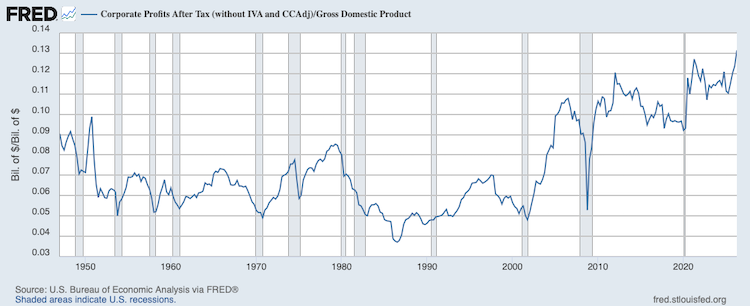
The surge subsequent to the dot.com bubble is noticeable. As is the sudden shuffling in the ranking of the top tier of business by market capitalization:
| 2000 | ($billions) |
| Microsoft | $586B |
| General Electric | $477B |
| Cisco | $366B |
| Walmart | $260B |
| Exxon Mobile | $260B |
| 2025 | |
| Apple | $3,572B |
| Microsoft | $3,085B |
| Nvidia | $3,052B |
| Alphabet | $2,468B |
| Amazon | $2,467B |
What stands out most is the rise to the top of the big technology companies. In just a couple of decades, the technology sector has gone from being on the frontier, some with absurd P/E ratios, to being the core of the economy with ratios within the bounds of reason.
The key, though, is the earnings these juggernauts generate. The reason that those ratios seem in line with history — mostly — is that all these companies are extracting enormous profits from their respective franchises. The level of competition each faces is apparently so low that they can rake in cash at prodigious rates.
As I said, what we need to examine is not the price in the P/E ratios, but the earnings. It is not unusual in history for businesses to be able to establish what appear to be impregnable sources of extraordinary profit (rents?) during a period of great technological transition. Having said that, just how many instances of “great transition” have we truly experienced during our era of large corporate dominance? Two or three? Maybe a couple more, but not a sufficient enough number to know whether what we are experiencing is a normal cycle that will be suppressed by subsequent competition and/or regulatory action. Are we due another great round of “trust busting”?
Those earnings suggest we are.
Back, briefly, to artificial intelligence.
Is it going to “change everything”?
In a word, no, but that’s only because we have gone through the great transition into the industrial world already. When everything, absolutely everything, was changed. As Dan Williams recently put it in one of his Substack posts:
“The Industrial Revolution transformed everything, including political and legal institutions, the structure of the economy, class and status hierarchies, human psychology, values, culture, gender relations, family structure, personal identity, ideologies, religion, and art, all of which interacted with each other in highly complex ways.”
Artificial intelligence is not going to have that same impact, not because it isn’t a major technology, but because it is still the playing out of the industrialization of life. AI is the industrialization of knowledge. It is not a post-industrial technology. On the contrary, it represents the logical next step in the capitalist capture and industrialization of domains that have, hitherto, been beyond its grasp. In this case, human knowledge is the target. It is steadily being gathered and made subject to the same industrial conventions that have already engulfed agriculture, manufacturing, and some services.
AI will certainly have long-term impacts on many aspects of modern life, just as electrification or the invention of the motor car did. But they, too, were functions of industrialization. Each of them had an impact deep into our way of life. They contributed, along with many other such technologies, to the total re-arrangement of everything in the way Williams describes. AI will be just one more such instance. Its ramifications will extend into daily life in ways we are only dimly aware of. It will undo some, but not all, of the existing changes brought upon by earlier technological changes.
But it will not usher in a total change.
Because it is simply another phase of technological innovation. And in the grand scheme of history, it is not a whole new way of life.
This is not my attempt to diminish the potential of AI. It is simply an attempt to situate it in a longer perspective.
Is AI disruptive? Yes.
Is AI a novel technology? Of course.
In many ways, perhaps, AI is the logical endpoint of industrialization. The application of industrial methods — organization, rationalization, replication, codification, and so on — in order to extract profit is a hallmark of modernity. Turning discovery into a replicable product for sale is the method of industry.
Which is what Anthropic is doing to knowledge.
It will produce all the same consequences of prior phases of industrialization: an environmental impact; externalities that need to be mopped up; worker repression; productivity gains; and the creation of wealth.
At what social cost we are yet to realize.
But, as long as we keep AI in proportion to just another industrial process, we all know how to deal with it.
That’s what we have politics for.
The people will have the last word. Not Anthropic.