Sissy Wants to Know. Thanks.
Quick question: I had always assumed that rising productivity implied rising wages. Am I right?
Yes, I know about the great divide since the end of the 1970s. Productivity carried on upwards. Wages rose, but as much. So the two no longer track in that happy coincidence that economist like to think as being inevitable.
It seems politics intrudes periodically and interrupts the pleasantries of economic models.
The fact of the great divergence over the past few decades has caused a lot of right wing economists to move about uneasily whenever the topic of distribution in the national accounts comes up in conversation. They all retreat into some form of the “a rising tide lifts all boats” argument as if the proportions have no relevance to society at large.
It reduces to a sort of “why can’t workers just be happy” attitude.
Sarah O’Connor’s article in yesterday’s Financial Times reminds us of the currency of this discussion. She wonders why we are still re-interpreting the effects, both long and short term, of the Industrial Revolution. In particular she points out that the argument ought not simply hinge on incomes. It ought also incorporate access to non-economic factors such as healthcare, education, individual agency, and so on. Wages alone are not the point of contention. People want to be paid. People want to live good lives. People want to be treated well.
This is very much the frontline in the battle over the relevance of economics. Do the economic measures, quantities, and thus modes of thought matter? Or are they so compact and specialized that they can be ignored in our arguments over the bigger issues?
The great enrichment — to use McCloskey’s happy phrase — has been an undoubted triumph over the past two hundred years. It has allowed vast swathes of humanity to escape the dreaded Malthusian trap.
Great.
But it also introduced other issues onto the political table. Just the sort of issues that O’Connor mentions. Security being key. Fairness being another.
Modern societies have outgrown their roots in the pre-industrial era. So the norms of those years are irrelevant. We live by different rules than our ancestors. Even recent ancestors. The cornucopia McCloskey applauds as a consequence of liberal norms and practices has brought with it new attitudes and new battle lines in politics.
Duh! I can hear you saying.
So, O’Connor is right. Why are we still discussing the origins and consequences of the Industrial Revolution? Why aren’t we focusing on how we, now, deal with what is in front of us? It’s almost as if we want to avoid dissension over how the spoils of our collective surge to prosperity are to be shared.
I wonder why?
Maybe it’s because of that dread phenomenon we call “democracy”. People just hate it.
They hate it because it represents a defeat for the traditional elite and a need to include people in the sharing who previously could be ignored.
Democracy was always a much dismissed concept throughout history because it represented the intrusion of regular people into decision making, and it was always equally assumed that regular people are not up to the task. They are inadequate in some way or another. They lack judgement. They lack education. They lack insight. They have no “skin in the game”. They cannot see the “big picture”. And they are always too self-interested — they do not, like their elders and betters, put the greater good ahead of their own.
Whose “greater good” I wonder?
So the modern, very modern as it turns out, intrusion of the masses into politics irritates anyone who thinks of themselves as having insight, education, skin in the game, big picture understanding, and/or judgment. In other words in annoys the elite. Especially the educated and asset owning elites.
In our more contentious moments we would call such elitists “capitalists”. They either own assets or they manipulate the technical details that support the creation and protection of those assets.
Which gets us back to that rising tide.
The elitist response to questions over the distribution of our prosperity usually decays into a simple one: why can’t workers just be happy with higher wages and stop moaning about safety, security, fairness and all those other things? Why can’t they, in other words, let capitalists get on with being asset accumulators? What’s wrong with that?
Capitalists hate democracy because it lurks in the background wanting to eat up a share of what capital “earns”. And capital “earns” on the basis of rising productivity. And rising productivity is the foundation upon which modernity is constructed. So, in the eyes of capitalists, democracy is a threat to their version of modernity more than simply a product of it.
It’s that simple. Or it’s that complicated. It depends on whose side you’re on.
Most economists avoid being drawn into these questions. After all, economic theory — that central redoubt of the elite — tells us that the distribution or our collective prosperity is directly dependent on our individual contributions to its creation. That’s the great lesson of the Marginal Revolution of the late 1800s. People get what they “deserve”. A friend of mine calls it Calvinist. I call it ideological. How does anyone measure individual contributions? Really. I mean really. Not on a piece of paper or in a simplified model. And certainly not in theory. I mean really.
Speaking of the marginal revolution, Alex Tabarrok who co-produces a substack by that name, wades into the discussion today with a short article under the heading: “The Labor Share Fell. So What?” Good timing. Maybe he read O’Connor’s article.
His argument can be reduced to this:
- Yes, the share of national income going to capital has risen. That’s due to the increasing “productivity of capital” — there’s no comment on rising productivity of labor
- But, wages have still gone up because the overall pie is growing
- So why the fuss? Workers only worry about rising wages. They never worry about things like “shares of national income” — distribution is an abstraction that means nothing to normal workers
Well said.
A better articulation of the tone-deaf consequences of being steeped in economic theory would be difficult to construct. It ranks right upon there with the defense of surge pricing that the even more tone deaf like to give us.
But distribution does matter. Just not in Tabarrok’s models.
It matters when capital intrudes into politics by arguing for reduced social spending — something that increases risk for workers and thus touches upon the factors O’Connor tells us worker do worry about.
It matters when the elite gets so wealthy that it can no longer relate or empathize with everyone else. It matters when access to safety, security, retirement, child care, healthcare, and so on are restricted to an ever smaller section of the population either because the elite has seen fit to cut public support for such things, or has sufficient purchasing power that it distorts the price of such things.
It matters a great big fat deal.
It matters enough to get regular folk angry enough to support whacky populists like Trump rather than follow the lead of the more “centrist” — i.e. elite acceptable — politicians.
And it matters really when it gets so egregious that oligarchs can pour money into the political and legal systems sufficiently that they, in effect, own those systems, and, as a result, destroy democracy.
I therefore recommend that Tabarrok stops pretending that a rising tide is, by itself, a good thing.
Perhaps he should read O’Connor’s column.
Especially the last paragraph or two where she quotes from Charles Dicken’s novel “Hard Times”.
She says this:
One man from the 19th century would be dispirited but not surprised, I think, that people in 2026 were still arguing about his era through the lens of statistical averages. In his novel Hard Times, Charles Dickens described a girl called Sissy, who was having a terrible time in her lessons. Her schoolmaster told her to imagine that her schoolroom was a nation in possession of “fifty millions of money”. Wouldn’t that mean it was a prosperous and thriving state?
“I said I didn’t know,” she relayed afterwards to a friend. “I thought I couldn’t know whether it was a prosperous nation or not, and whether I was in a thriving state or not, unless I knew who had got the money, and whether any of it was mine. But that had nothing to do with it. It was not in the figures at all.”
Sissy seems to be sharper than Tabarrok. She is concerned over who got what. It does matter to her. Fairness, it seems, matters.
Alternatively, maybe she needs to learn her place and accept the diktat of marginal economics. She got what she deserved. Obviously. So why discuss distribution? Why get involved in politics when economics has all the answers.
No wonder economists are sometimes looked at as if they have two heads. Do they really believe workers have no idea what’s going on? Or that they are so politically illiterate that matters of distribution ought be left to their elders and betters?
Meanwhile, I have quick question for economists of the Tabarrok ilk: what are interest going to be in 2035? I am a rational consumer and want my perfect information. I am just checking so I can make sure I conform with your models. Oh, and, which is it … her marginal productivity or the market rate for labor that will dictate Sissy’s wages? Or are they same? In which case is labor “homogenous”? In which case how does it contribute to the productivity of capital? Or is it the other round? Or all of the above? And when Sissy gets a loan where does the money come from? The bank’s safe? Or is it just created out of thin air?
I know you have all the answers.
Just asking for my friend Sissy.
Thanks.
Addendum:
Here is the chart Tabarrok uses as he explains why we ought not fare about distribution …
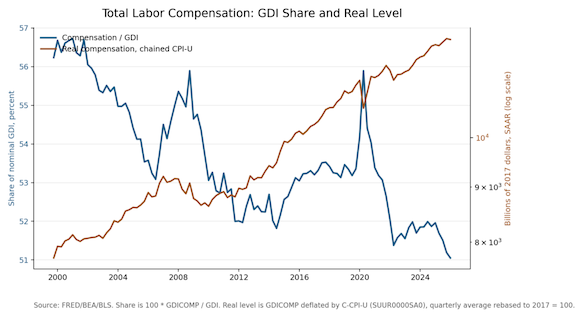
He rather gleefully points to those two spikes in the downward trend of the labor share as being demonstrations of the dangers of being a capitalist: radical adjustments in the economy such as sudden drops in the stock market etc, have a more radical impact on capital income than labour income. Hidden behind his commentary is the ideological message that capitalists take more risk than workers and thus “deserve” their greater share of the pie. What he misses is that the volatility of that downward trend is precisely why workers worry about safety, security, and all this things economists ignore. It is why distribution matters. And why politics, rather then economics, is the forum for distributional debates. Economics has absented itself because of its belief in the total efficacy of market outcomes.
Here are his words describing those two breaks in the trend …
“The recessions in 2008 and 2020 are worth noting because these are periods when the labor share was high and locally at a maximum! The reason, of course, is that GDI was shrinking in these periods more than labor compensation. In other words, capital takes a bigger hit than labor in a recession. This is a good reminder that a high share of GDI is not what workers most care about–a high absolute level of GDI is more important for the bottom line.”
